 Cecil Round was clearly well regarded as an artist as he was commissioned to paint the portraits of many influential people – amongst them, we read ‘between the sheets’ of the Lady’s Pictorial of 25 December 1886, was Alexander Meyrick Broadley (1847-1916).
Broadley was a British barrister, author, company promoter and social figure. He is best known for being the defence lawyer for Ahmed ‘Urabi (otherwise known as Aribi Pasha), an Egyptian nationalist who was put on trial in Cairo for insurrection after the failure of the ‘Urabi Revolt (1879-1882).
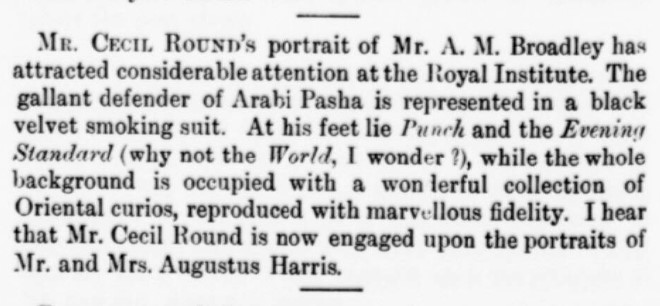
Earlier in the year, we discover in The Shields Daily News of 25 June (1886) that the portrait, at that time unfinished, was displayed at a ‘bachelor party’ hosted by the sitter, Mr A. M. Broadley. The following extended quotation from a Lady’s London Letter column, gives an insight into Broadley’s social life as a ‘modern man’ of his time:
“Bachelor parties are growing quite popular in London. I do not mean the old-fashioned ones, dinners of men alone, with smoke and drink for hours after, accompanied by what men by themselves suppose to be witty and amusing talk. Not this at all. The modern bachelor gives his afternoon for ladies as well as gentlemen, in defiance of the supposed need for a hostess.
“Mr Woodall, M.P., the Surveyor General of Ordnance, gave one the other day. I had a card, but did not go, having another engagement. I heard, however, that the afternoon was not brilliantly successful, because there were not enough men there!
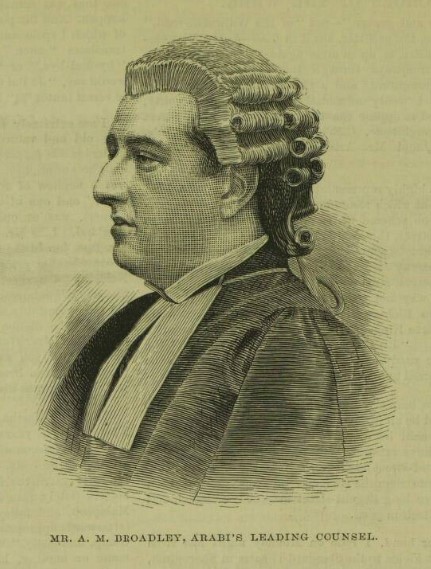
SOURCE: The Illustrated London News (1882-11-18). This likeness is included for illustrative purposes but is NOT the portrait referred to, by Cecil Round.
“No such complaint could be made against the ‘Musical afternoon,’ given on Tuesday, by Mr A. Broadley, the famous Counsel, who defended Arabi Pasha. His pretty rooms are decorated with all manner of Eastern curiosities, including many relics of Arabi, gifts from the Kasre decorated with and portraits of crowds of distinguished people (poor Fred Burnaby amongst them) hanging on the walls, and a capital portrait of the host by Cecil Round standing on an easel, being not quite finished.
“In these rooms Mr Broadley put a nice spread, wonderful cakes, iced souflees, ‘oups’ of all kinds, and tea and coffee, and there he had quite a crowd of ladies and a lot of men: Elizabeth Countess of Harrington, Lady Fanny Fitzwygram, Lady Gorst, Lady Anna Chandos Pole, Lord Lamington, Hon. W. Cochrane Bailie, and I know not how many more people with famous names with and without handles.
“There were, I should say, a hundred guests. The singing they came to listen to was something very superior to that which is heard at the usual run of parties, for Madame Marie Roze sang four times in the afternoon, and Miss Marion Burton (the contralto of the Carl Rosa Company) four times, and Messrs Barrington, Foote, Scovel, and Carpi also helped, and Mr Capper gave some thought reading. Mr Broadley’s party was a success indeed; many hostesses would envy this bachelor his afternoon.”
Of Broadley’s 40th birthday party the following year, we read ‘between the sheets’ of The York Herald of 21 July 1887:
“Princes and princesses, peers and peeresses, bishops and baronets, diplomatists and doctors, members of Parliament and musicians, authors and artists, actors and actresses availed themselves of the opportunity of offering birthday congratulations”.
It was around this time, that Broadley was appointed de facto editor of Edmund Yates’ periodical World. Yates was to become another of Cecil Round’s sitters, with his portrait being exhibited at the New Gallery (121 Regents Street, London) – to much acclaim!
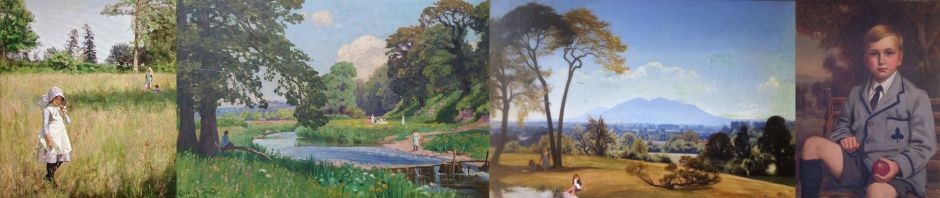
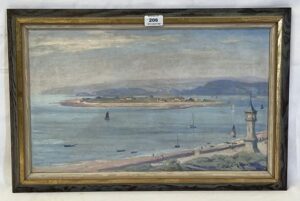
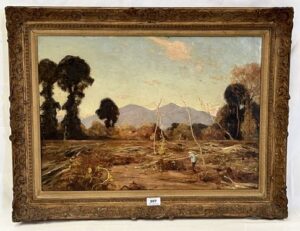
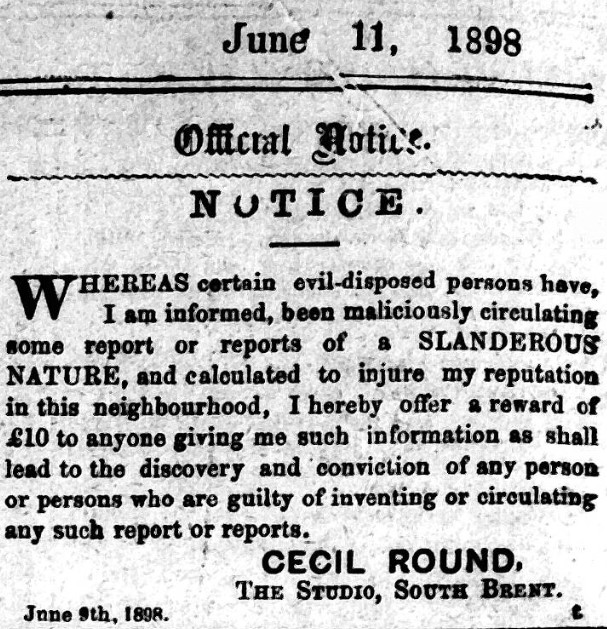
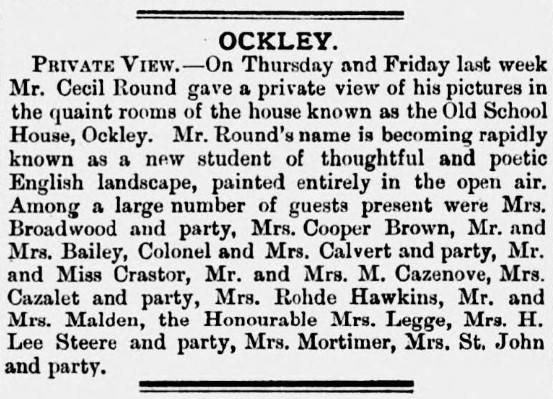
 Today marks the fifteenth anniversary of our Cecil Round website. What started out as an online gallery of some twenty or so pictures, now includes over eighty examples of Cecil Round’s work.
 Following the death of Cecil Round in June 1933, we find ‘between the sheets’ of the Western Morning News of 12 July 1933, a formal notice for any Persons having a claim against the Estate of the late Cecil Mendelssohn Round, to come forward to S. W. Page, Son and Elias of Wolverhampton. The advert includes details about where Cecil Round had resided prior to his death, along with the address where he sadly passed away.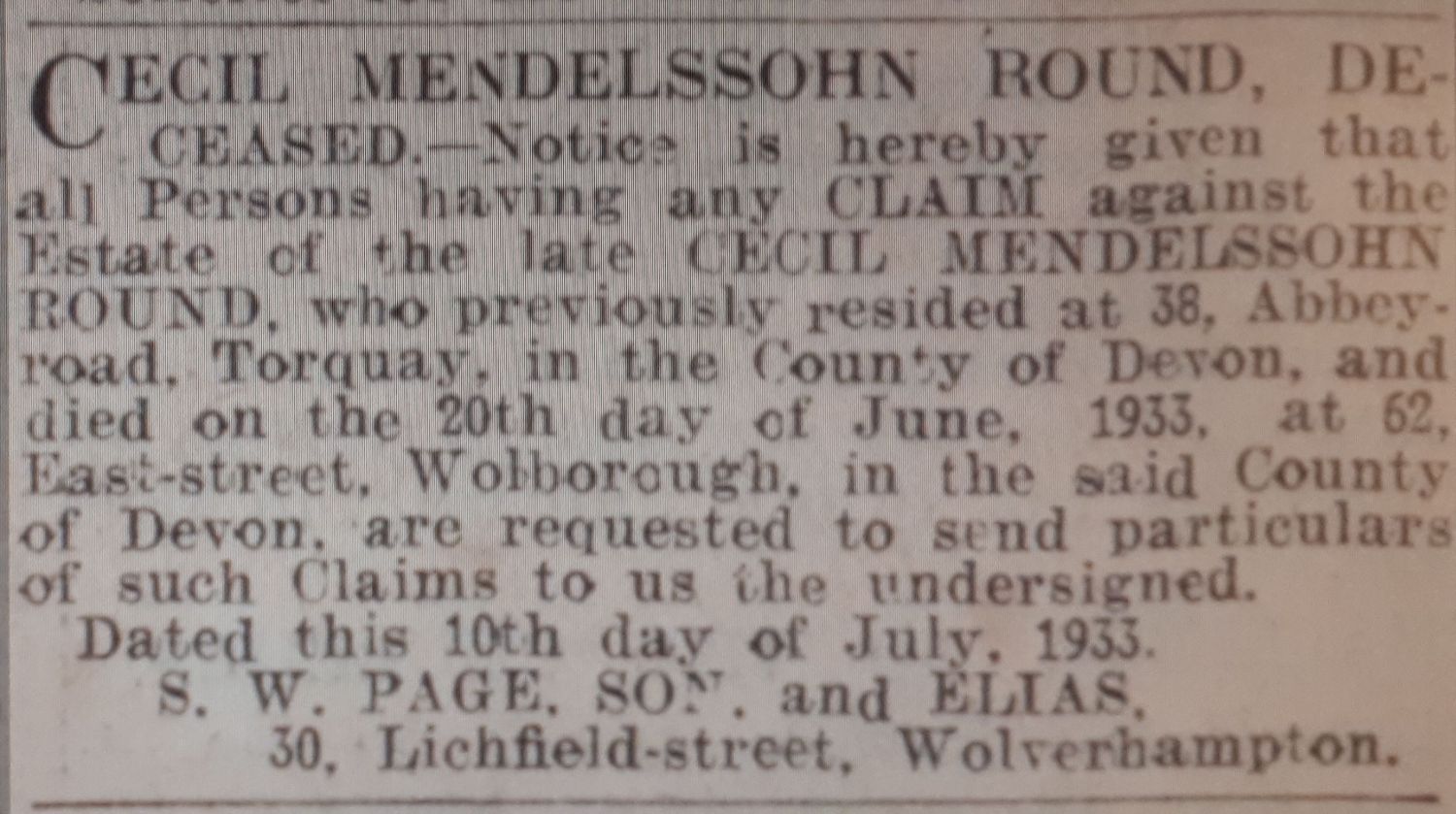
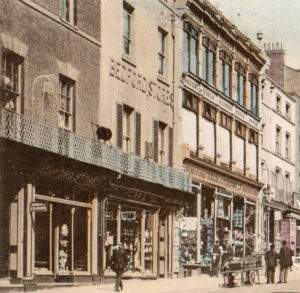 “Visitors to Messrs. Burgis and Colbourne’s stores should devote a moment to the inspection of a painting – on the ground floor, and in an excellent light – of a pretty little English lady of some sixteen summers – Muriel, daughter of Sir Paget Bowman, Bart., of Joldwynds, near Dorking, Surrey. It was exhibited some few years since in the Royal Academy, and is from the brush of Mr Cecil Round, an exhibitor in the Paris Salon as well as in the Royal Academy. The picture, 3ft. by 2ft., is a three-quarter length portrait, and represents a typical English girl, with clear complexion, blue eyes, and hair of bright auburn. She holds in her hand a few primroses, and is robed in white, simplest yet daintiest of girlish dresses.
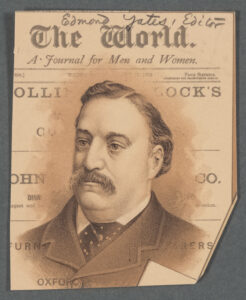 “Mr Round began his career early, and it is not without interest to know that it was in the Midlands that he first exhibited. This was at the age of sixteen, when he [exhibited] a landsacpe, which was shown at one of the exhibitions of the Royal Society of Artists, Birmingham. A year later, when a youth of seventeen, his first picture was hung on the line at the Royal Academy. Since that time he has numbered amongst his sitters many well-known persons, including Mr Edmund Yates, the editor of the World, the intimate friend of Charles Dickens, and one of the most conspicuous and successful journalists of his day. Mr Yates’ portrait was a full-length, the canvas measuring 8ft. by 6ft. It was exhibited at the New Gallery, Regent Street, London, and regarded as a remarkably fine likeness. Mr George Augustus Sala, at a private view, was struck by the life-like effect, and gave vent to his admiration in epigrammatic fashion: ‘It is more like Yates than Yates is like himself,’ he said.